The Dancing Plague of 1518: four hundred people who couldn't stop dancing, and some died trying
Physicians, chroniclers and the city council put the outbreak on record. Five centuries later, there is still no consensus on what caused it.
- When
- July–September 1518
- Where
- Strasbourg, Alsace, France
- Status
- Under debate competing explanations, no consensus
By The Echoes of the Past team. Published November 2, 2026. 5 min read.
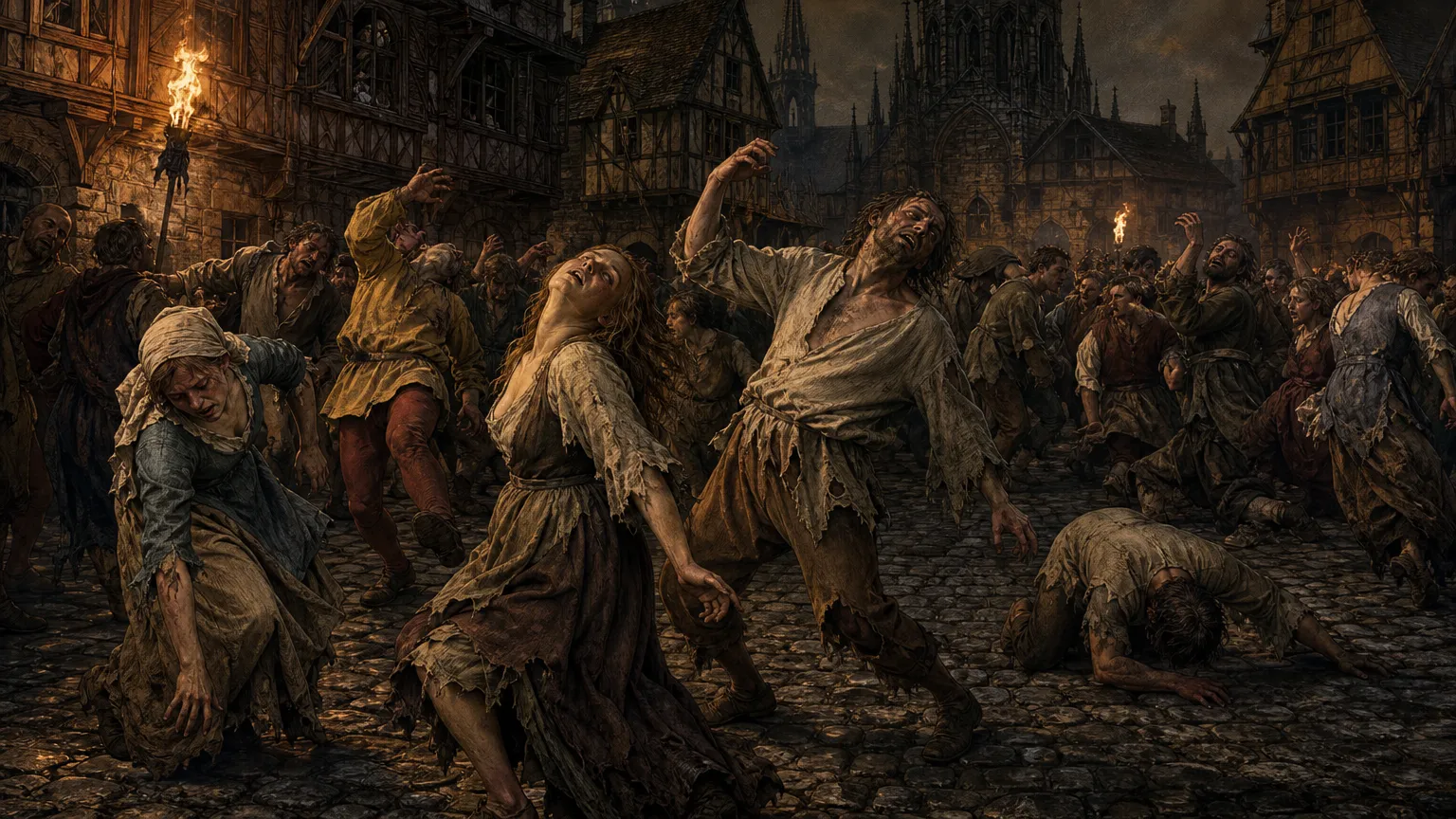
In mid-July 1518, a woman named Frau Troffea began dancing in a street in Strasbourg, then part of the Holy Roman Empire.
She didn't stop.
She danced for days. Without music. Without stopping to eat or sleep. Her feet bled, but she kept going. Within a week, thirty other people had joined her. Within a month, the number had reached four hundred.
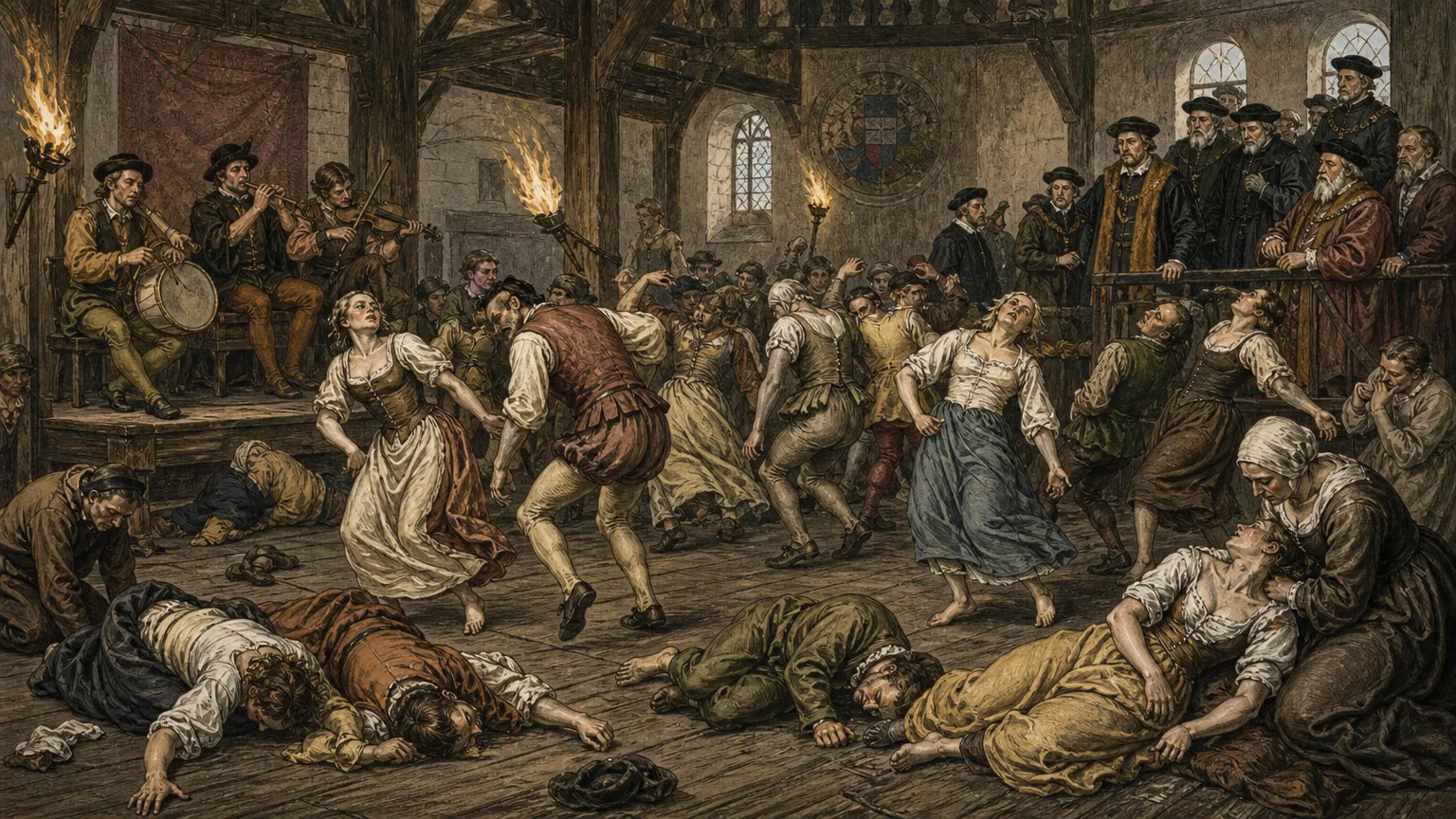
The city authorities, following the advice of physicians, provided a hall, professional musicians and dance platforms, believing the best cure for the compulsion was to let it burn itself out. The dancers kept going. Some died of exhaustion, heart attacks or heatstroke.
In September 1518, the outbreak ended as mysteriously as it had begun.
This really happened. It is documented in medical records, sermons, city chronicles and notaries' notes from the time. And to this day there is no scientific consensus on what caused the Dancing Plague of 1518.
The historical sources
The 1518 dancing outbreak in Strasbourg is one of the best-documented medieval events of its kind. The sources include:
- records of the Strasbourg city council, which discussed the problem in formal meetings and ordered measures;
- contemporary chronicles in German and Latin that describe the event in specific detail;
- notes by physicians who examined the dancers;
- church documents by preachers who interpreted the event as divine punishment.
Historian John Waller, of Michigan State University, who spent years researching the case for his book A Time to Dance, A Time to Die (2008), analyzed all of these sources and concluded that the outbreak was real: not metaphorical, not exaggerated, not misread by the chroniclers. Hundreds of people danced compulsively for weeks in Strasbourg in 1518.
The theories and what supports them
Ergotism: rye, the region's main grain at the time, was often contaminated by the fungus Claviceps purpurea, whose alkaloids have hallucinogenic and spastic effects. Mass contamination could cause compulsive behavior and hallucinations.
The problem: typical ergotism causes spasms and convulsions, not coordinated dancing. And the dancers of 1518 were described as conscious and in distress, not in a hallucinatory state.

Mass hysteria, or mass psychogenic illness: the explanation favored by most modern historians. Under conditions of extreme collective stress (famine, disease, religious fear), human groups can develop real physical symptoms with no identifiable organic cause. According to this theory, the outbreak spread through social contagion: watching the dancers triggered the same behavior in predisposed onlookers.
The context of 1518 matters: the region was living through food shortages, outbreaks of syphilis and smallpox, and intense religious terror about eternal salvation. The population was under exceptional collective stress.
Mass hysteria is a documented phenomenon that still occurs today: outbreaks of unexplained physical symptoms in groups (schools, factories) that spread through observation and social contagion. The 1518 case would be the largest and most extreme historical example on record.
The cult of St. Vitus: in the region's religious tradition, St. Vitus was associated with protection against illnesses that caused tremors and involuntary dancing. There are documented pilgrimages to the shrine of St. Vitus after the outbreak, which suggests that people at the time interpreted what happened as possession or a punishment linked to the saint.
John Waller proposes that religious belief may have been a causal factor: people who genuinely believed they could be possessed by St. Vitus, under extreme stress, entered dissociative states that showed up as compulsive dancing.
Why the authorities' decision may have made everything worse
One of the most fascinating aspects of the 1518 outbreak is how the official response amplified it.
Strasbourg's physicians diagnosed the problem as "natural heat of the blood," an excess of energy that needed to be spent. The prescription: more dancing. The city council opened halls, hired musicians, built platforms. In practice, it was creating infrastructure for the outbreak to grow.
If the mass hysteria theory is correct, that response was exactly the wrong one: by creating a social environment that legitimized and encouraged the dancing, the authorities removed the psychological barriers that might have contained its spread. Instead of treating the dancers as people with a health problem, they treated them as participants in a public event, which invited others to join in.
The outbreak ended when the religious authorities took control, sent the dancers on a pilgrimage to the shrine of St. Vitus and banned music and public dancing in the city. The change of framing, from a medical event to a religious event with a ritual solution, may have provided the psychological mechanism that allowed the dancers to stop.
What the 1518 outbreak says about us
The Dancing Plague of 1518 is studied today not just as a historical curiosity, but as a case study in mass psychogenic phenomena.
Similar outbreaks, if less dramatic, keep happening. It is the same mechanism that, according to the most widely accepted theory, led hundreds of American soldiers to fire 1,400 anti-aircraft shells during the Battle of Los Angeles in 1942 at something no one could identify: collective fear produces behavior that goes beyond any individual logic. In 2011 and 2012, teenagers in LeRoy, New York, developed involuntary symptoms (tics, spasms, vocalizations) that spread through their social group. In 2021, teenagers around the world developed symptoms similar to those of Tourette syndrome after watching TikTok videos by creators with the disorder.
The human nervous system's capacity to develop real physical symptoms in response to social pressure and psychological contagion is well documented. What the 1518 case suggests is that this phenomenon can, under extreme collective stress and without proper intervention, escalate to a scale that kills people.
What Frau Troffea felt that July day when she began to dance (whether it was anguish, trance or compulsion) is not recorded in any of the surviving sources. We know no more about her than we know about the Isdal Woman: two women whose inner lives remain out of reach despite all the outward documentation.
She was dancing. And she couldn't stop.
For other events in which collective human behavior produced incomprehensible results, read about the Plague of Athens, where social collapse was as fast as it was inexplicable, and the Dyatlov Pass incident, where the group's behavior in its final moments is just as disturbing. For the world of alchemy and magic in Europe, see Nicolas Flamel and Cagliostro.