The Nazca Lines: who drew them, why, and why they only make sense from above
A 96-meter hummingbird, a monkey with a spiral tail and more than 800 straight lines: what we know about who made the Nazca geoglyphs, and why.
- When
- c. 100 BC–AD 800
- Where
- Pampa de Nazca, between Nazca and Palpa, Peru
- Status
- Partly explained the main explanation is accepted; details remain open
By The Echoes of the Past team. Published November 2, 2026. 6 min read.
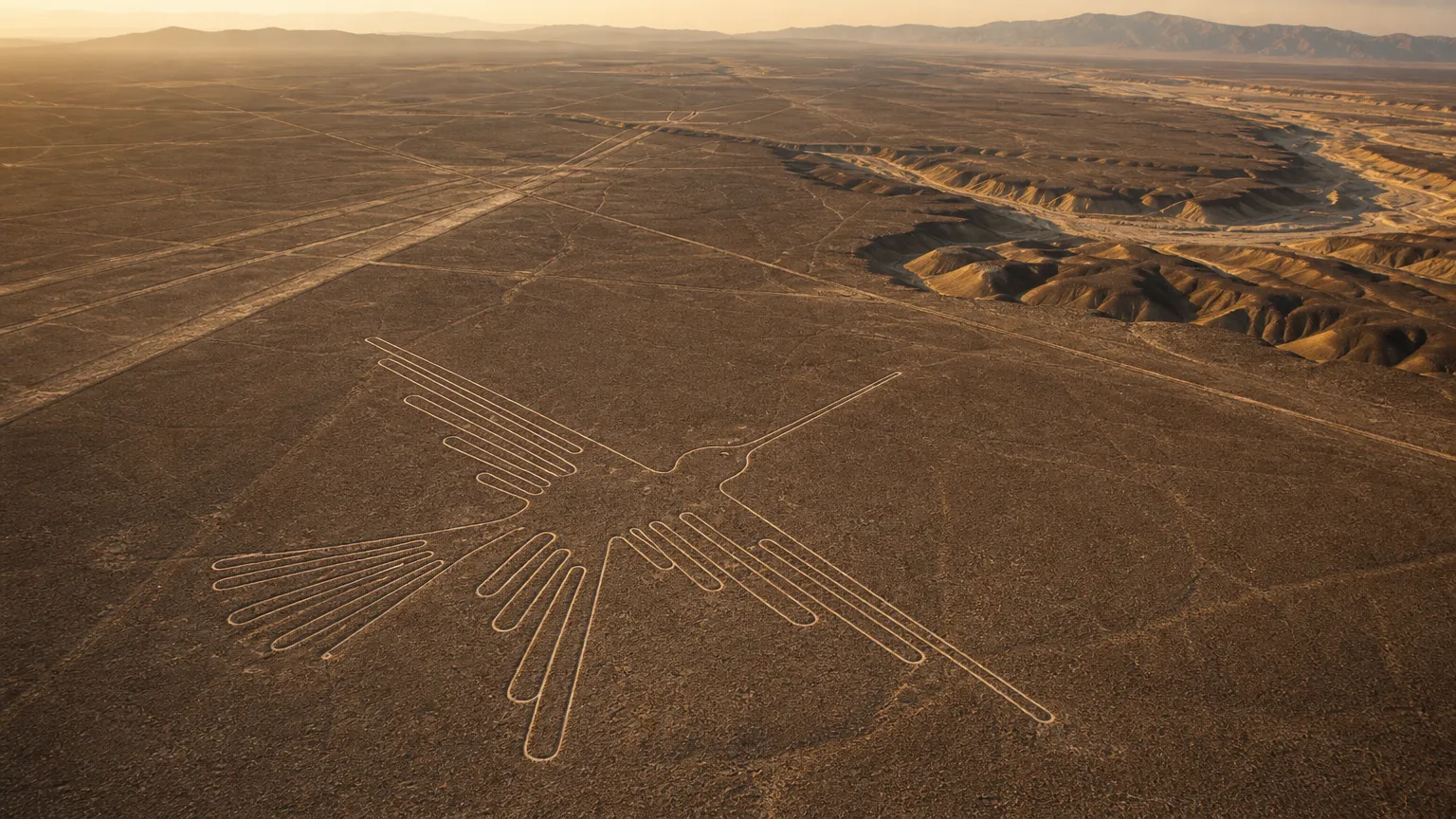
Imagine working on a jigsaw puzzle that only makes sense when you look at it from outside the box: literally from outside, from hundreds of meters up. That is how the Nazca Lines worked for nearly two thousand years before any human being could see them whole.
They lie in the Nazca desert, in southern Peru. They are geoglyphs (drawings made on the ground) that depict animals, plants and geometric shapes. The smallest is a few meters across. The largest exceeds 370 meters. And all of them were made by a civilization that had no airplane, no balloon, no way at all of seeing the finished result of its own work from above.
Or did it?
What lies in the desert
The Pampa de Nazca is a desert plateau of roughly 450 square kilometers, located between the towns of Nazca and Palpa, in Peru. The climate is extremely arid (less than 20 millimeters of rain a year) and almost windless. Those conditions are responsible for the exceptional preservation of the lines over two millennia.
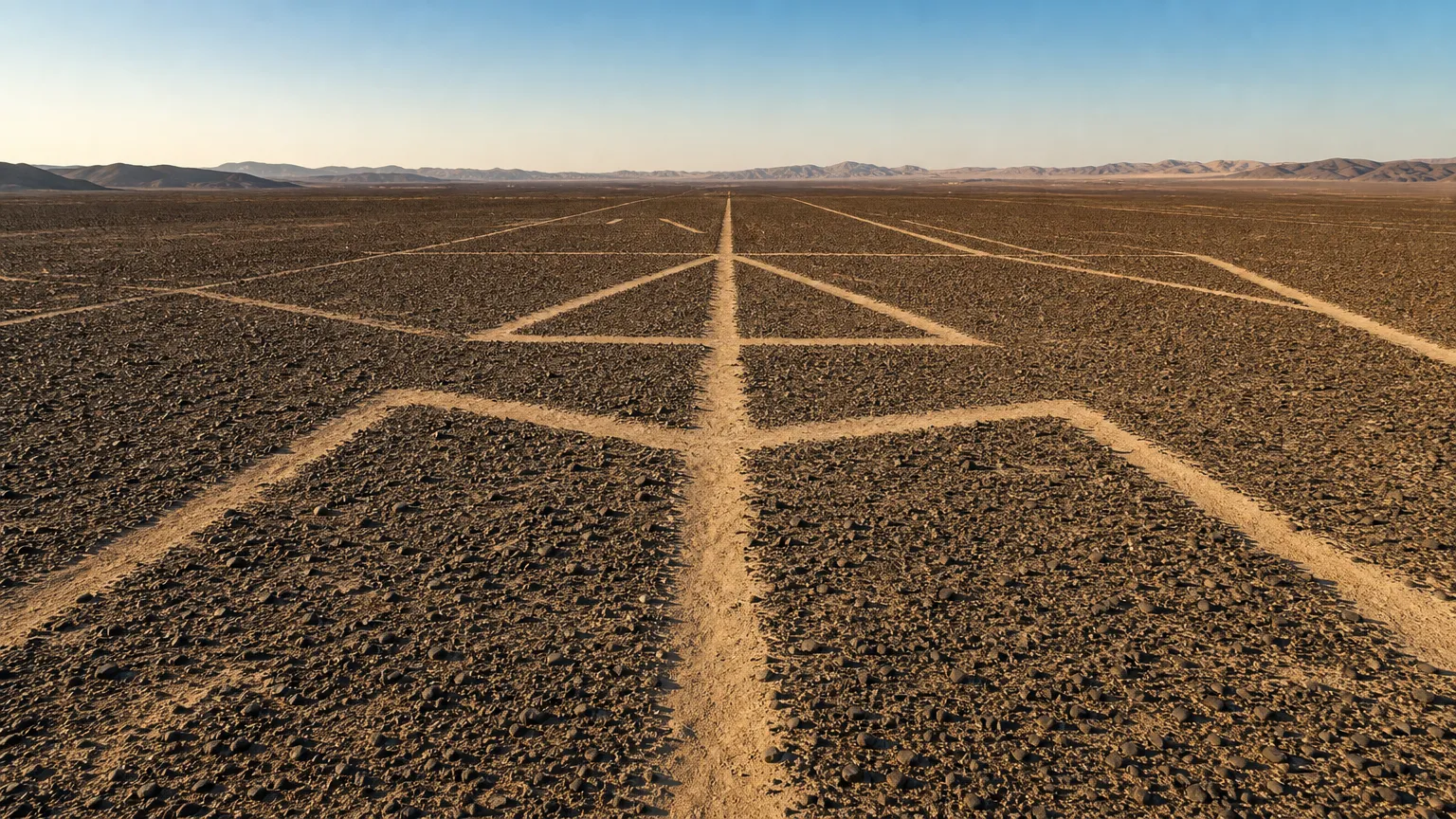
The lines were made by the Nazca people, who lived in the region from about 100 BC to AD 800. The technique is well understood: the desert surface is covered with reddish, iron-oxide-coated stones that, once removed, expose the lighter sand underneath. By clearing the stones in deliberate patterns and piling them along the edges, the Nazca created the lines with a simple technique, but one that required precise planning.
The figures include a hummingbird (96 meters long), a spider (46 meters), a monkey with an elaborate spiral tail (93 meters), a heron (277 meters), a condor (134 meters), an "astronaut" (oddly enough, a 32-meter humanoid figure that earned the nickname from the shape of its hands) and dozens of other figures of animals, plants and abstract forms.
In all, there are more than 800 straight lines, 300 geometric figures and 70 drawings of animals and plants. Some of the straight lines run for kilometers in a perfectly constant direction, crossing hills and valleys without veering.
The woman who spent her life in the desert
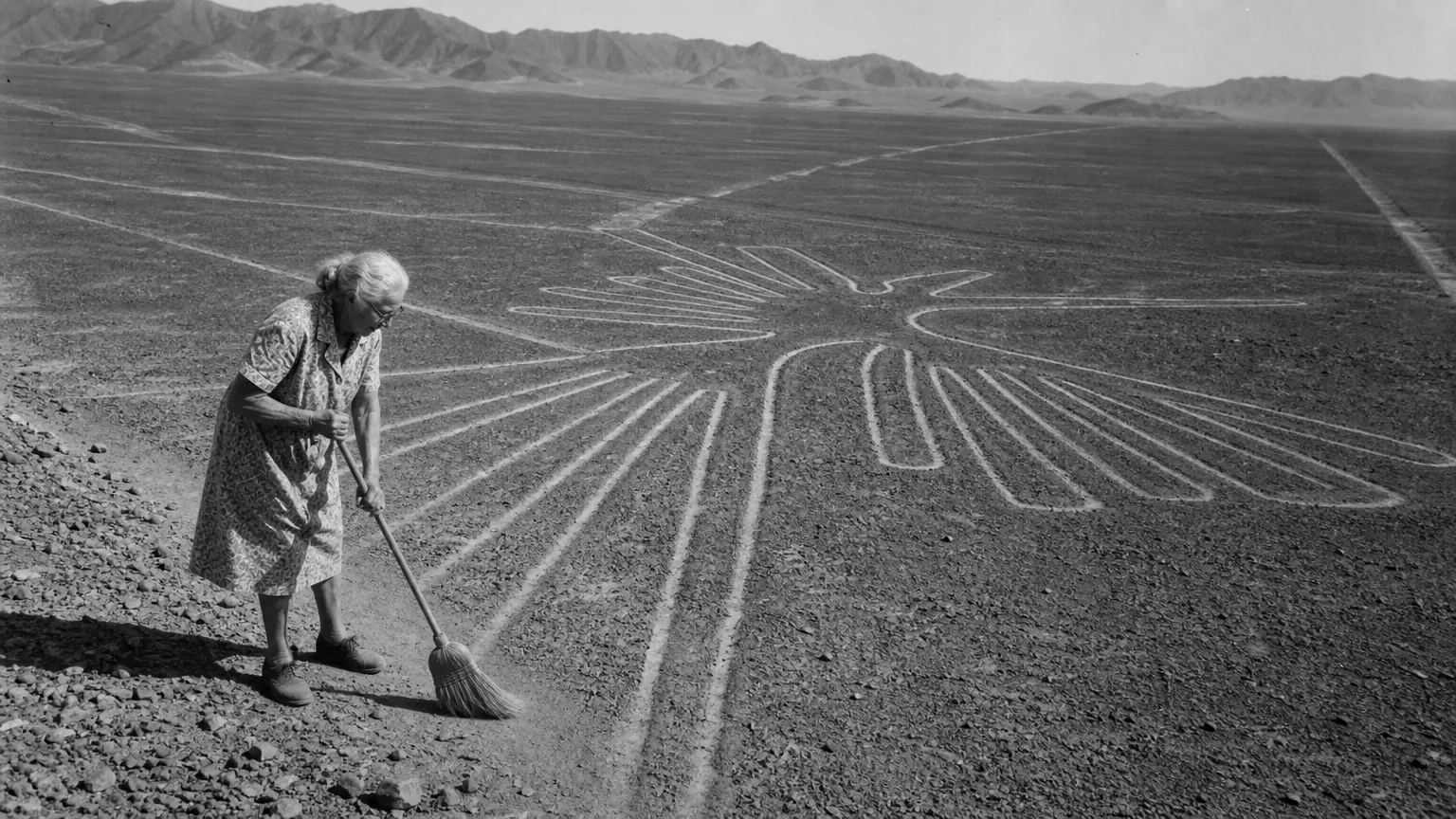
The most important researcher in the history of Nazca was Maria Reiche, a German mathematician and archaeologist who arrived in Peru in 1932 and spent fifty years studying the lines. She literally lived in the desert, sweeping the figures by hand with a broom to keep them clean and measuring and mapping every line with millimeter precision.
Reiche proposed the astronomical hypothesis: the lines would form a giant calendar, with the figures and straight lines pointing to positions of the sun, the moon and the stars on astronomically significant dates, such as solstices, equinoxes and the rising of certain stars on the horizon.
Later research partly confirmed and partly refuted Reiche's hypothesis. Some lines have astronomical alignments that appear deliberate. Most, however, point to nothing astronomically significant, at least based on what we know today about what the Nazca observed in the sky.
Serious hypotheses and what the evidence supports
The debate over the Nazca Lines is an interesting case of serious scientific hypotheses competing with popular, unscientific explanations for the same phenomenon. The same pattern repeats at Göbekli Tepe, where the mere existence of a 12,000-year-old monumental temple challenges decades of archaeological theory.
Ritual-religious hypothesis (currently predominant): the lines were walked during rituals tied to the worship of water and fertility. The Nazca desert was, and still is, a region of extreme water scarcity, and the peoples who lived there had an intense relationship with water resources. Research by archaeologist Anthony Aveni and his team suggested that the straight lines may have been ritual paths walked in procession, and that some lines point toward springs or water runoff routes. The hypothesis gains strength from the fact that the lines, seen from the ground, are perfectly walkable paths.
Astronomical hypothesis (Reiche's, partly supported): some figures and lines have deliberate astronomical alignments. Not all of them, which complicates the most radical version of the hypothesis but does not rule out the idea that astronomy was one component of the system.
Aerial visibility hypothesis (not satisfactorily explained): the fact that the figures only make full sense from above remains the most unsettling element. The most widely accepted explanation is that the Nazca worked from smaller-scale models that were then enlarged using grid systems and measuring cords, a technique modern experiments have shown to be feasible. But the aesthetic experience of a drawing its own maker will never see whole is strange enough to remain intriguing.
What has been discovered recently
Between 2016 and 2022, researchers from the Yamagata-Nazca project, led by Yamagata University in Japan, used drones and artificial intelligence to analyze high-resolution images of the desert and identified more than 300 new figures that had never been cataloged.
The new figures include depictions of fish, snakes, birds and human figures, smaller and more detailed than the classic ones. Some appear to predate the best-known figures, which suggests that the geoglyph phenomenon at Nazca lasted longer and was more complex than previously thought.
The discovery raised questions about how the different periods of line-making relate to one another: were they made by the same culture over centuries? By different groups? With different functions at different times?
The answer is still being worked out.
What remains unexplained
Why would a people who could not fly create art that only makes full sense when seen from the air? The technical explanation (enlargement by grid) answers the "how," but not the "why pursue that effect." If you never saw the hummingbird whole, what drove you to build it?
One possibility: the figures were not meant to be seen by humans. They were meant to be seen by deities or supernatural forces that dwelled in the sky. The art did not need to be appreciated by its makers; it needed to be offered to the beings who looked down from above.
This hypothesis is consistent with the cosmology of many Andean cultures, which included deities of the sky, the sun and the mountains that had to be honored with offerings suited to their point of view.
It is a hypothesis, not an established fact. But it is a hypothesis that makes sense within the cultural context in which the lines were created.
The Nazca Lines are one of South America's greatest enigmas, but not the only one. Read also about Sacsayhuamán and its impossible stones and about the sunken city of Dwarka, which Hindu texts describe as swallowed by the sea. For a mystery of a different kind, but just as deep, see the Voynich Manuscript.